100 Useful .NET Tips & Tricks April 15, 2011
Posted by Abhijit Jana in .NET 4.0, ASP.NET 4.0, Debugging, Tips and Tricks.Tags: asp.net 4.0, C#, dailydotnettips, Debugging, Silverlight 4.0, Tips & Tricks
1 comment so far
Daily .NET Tips is aiming to sharing useful coding tips and tricks for .NET Developers. This site completely design for sharing Tips and Tricks, useful Code Snippet which anyone use in daily development work and targeted anything related with .NET. I started with this new site few months back and with in short time period we have total 100 Tips which mainly focused on the practical oriented problem. You can find tips related with C#, ASP.NET, Silverlight, WPF, WCF, JQuery, WP7 etc.
To know more ……
Visit http://dailydotnettips.com
Subscribe Tips to your mail box : http://bit.ly/hFAhop
For Quick Update Follow : @dailydotnettips
Thanks to all the contributors Abhishek Sur, Prayan Rana, Jebarson Jebamony, Atul Verma,Shravan Kumar who spends their time and shared tips.
Looking forward more contribution from all of you.
If you want to contribute your tips at http://dailydotnettips.com , please contact with me via Contact Page.
Thanks !
AJ
10 ASP.NET Tips and Tricks April 3, 2011
Posted by Abhijit Jana in ASP.NET 4.0, Tips and Tricks, Visual Studio 2010.Tags: ASP.Net, MVP, Tips & Tricks
1 comment so far
Here I am sharing 10 ASP.NET Tips and Tricks most of them related with Grid View Control
How to change GridView column alignments for dynamic data source ?
How to pass multiple values using GridView HyperLinkField ?
Displaying Custom Messages / Images with NULL Value in ASP.NET GridView
Display custom messages or images when there is no records in GridView Data Source
How to Display “Yes” or “No” Instead of Checkbox while binding Boolean value with GridView ?
How to expand specific Tree View Node programmatically in ASP.NET ?
Run ASP.NET Web Application from Command Prompt
How EnableViewStateMAC Makes ViewState Secure ?
Disabling button when performing some operation in ASP.NET
How to remove a persistent cookies before Expiration time ?
To know more Tips and Tricks Follow @dailydotnettips and visit http://dailydotnettips.com
On a side note, I would like to congratulate couple of my friends, first a key community contributor on WCF, Dhananjay Kumar for renewing Microsoft MVP – Connected System again for year 2011. He blogs at http://debugmode.net/ and his twitter id @debugmode_ . and second one Krishna Chaitanya T for Microsoft MVP – Internet Explorer . He is a Web Geek, do lots of research on web technology. He blogs at http://www.novogeek.com/ and his Twitter ID @novogeek . Good job guys !!
Download PPT – “Caching Enhancement in ASP.NET 4.0” – Virtual Tech Days – 9th Feb 2011 February 9, 2011
Posted by Abhijit Jana in .NET Community Events, ASP.NET 4.0.Tags: asp.net 4.0, caching, Events, Microsoft, Virtual Tech Days
5 comments
Today I delivered an 1 hour session on “Caching Enhancement in ASP.NET 4.0” at Micro
soft Virtual Tech days 2011. It was the Day 1 of Virtual Tech Days and I presented the 4th session on Developer Track 1, from 3.00 PM To 4.00 PM IST. Thanks to all of you for attending my session. In this session I have discussed about ASP.NET 4.0 Caching Enhancement . I started with fundamentals of ASP.NET Caching to make sure all the attends are in same page. In Caching Quick Tour section I have talked about why Caching ? What are the different types of caching ? How Caching works ? etc. Then I have discussed about New Object Caching API in .NET 4.0. In this section I have talked about new Memory Cache API, there Implementation using System.Runtime.Caching . I have also shown how we can use same set of API in an Winforms / WPF / Console Application. Followed by, I have explained how we can extend the Object Caching by implementing MemoryCache Class.
Details explanation on Compression Enabled Session for SQL Server and State Sever Session Mode in ASP.NET 4.0 January 19, 2011
Posted by Abhijit Jana in ASP.NET 4.0, General.Tags: asp.net 4.0, codeproject, CompressionEnabledSEssion, Sate Server, SQL SErver
4 comments
While we are talking about state management we consider Session is one of most useful server side state management mechanism for a web application. In ASP.NET mainly we are having two type of state management 1. In Process and 2. Out Process . “In process” is the by default session
storage mode for ASP.NET Web application and this is taken care by worker process in IIS. When it comes under Out Process we can use either of state server or SQL Server to persist session data. In case of In Process, session data stored in In memory of worker process. But when we are talking about “OutProc” session mode, we need to ensure that session data should be “Serialized” first . So, when we are moving session data from Web Server to Out Process Server ( State Server or SQL Server ) it can be a performance overhead based on the size of data that we are storing in Session.
ASP.NET 4.0 comes with a new option for compressing the Session data with Out Process Session mode. To enabling this functionality we need to add “compressionEnabled=”true” attribute with the SessionMode in web.config .
Programmatically Changing Session State Behavior in ASP.NET 4.0 January 15, 2011
Posted by Abhijit Jana in ASP.NET 4.0, General, Visual Studio 2010.Tags: asp.net 4.0, codeproject, HttpModule
9 comments
Session is one of most important state management in ASP.NET. We can enable or disabled session state either in web.config or using @Page directive’s EnableSessionState attributes. But there was no provision to change the session state at runtime till date in ASP.NET. But using ASP.NET 4.0, we can change the session state programmatically . The .NET 4.0 framework adds a new method SetSessionStateBehavior to the HttpContext class for ASP.NET. This method required SessionStatebehavior value to set the current session mode. To call SetSessionStateBehavior simply create a new HttpModule by Implementing IHttModule and hook the BeginRequest event. Most important you can only use the SetSessionStateBehavior until the AcquireRequestState event is fired, because AcquireRequestState Occurs when ASP.NET acquires the current state that is associated with the current request
While calling SetSessionStatebehavior, You can pass the following values as SessionStatebeha
vior :
- Default: This is default setting which means everything works as before
- Disabled: Turned of Session Sate for Current Request.
- ReadOnly: Read only access to Session State;
- Required: Enabled session state for both Read and Write Access;
When we can use HttpContext.Current.Items to stores data in ASP.NET? January 14, 2011
Posted by Abhijit Jana in ASP.NET, ASP.NET 4.0, Tips and Tricks, Visual Studio.Tags: ASP.Net, codeproject, HTTPContext, Session
8 comments
To answer this question In a single statement, you can use HttpContext.Current.Items for very short term storage. By Short term storage means, this data is valid for a single HTTP Request. There are many confusion around regarding storing data in HttpContext.Current.Items and storing data in Session variable. In this blog post I am going to describe what are the different scenarios where we can use HttpContext.Current.Items and what is the exact difference with session variable.
Items collections of HttpContext is and IDictionary key-value collections and that are shared across a single HTTPRequest. Yes, HttpContext.Current.Items valid for a single HTTPRequest. Once after processing, server information is sent back to the browser, the variables that were set in the Items[] collection will lost. Where as for Session Variable, information valid for multiple request as this is user specific. The session variable only expires either on Session Time Out or explicitly clear the values.
Microsoft Community Tech Days – Hyderabad – 18th December 2010 December 16, 2010
Posted by Abhijit Jana in ASP.NET 4.0, Community TechDays.Tags: Community Events, Community TechDays, Events
2 comments
Microsoft Community Tech Days in Hyderabad Scheduled on 18th December 2010. This time I will be speaking on one of my favorite topic “ASP.NET 4.0 State Management Improvement – Deep Dive”.
What is Community Tech-Days?
The Community Tech-Days website says “Dive deep into the world of Microsoft technologies at the Community TechDays and get trained on the latest from Microsoft. Build real connections with Microsoft experts and community members, and gain the inspiration and skills needed to maximize your impact on your organization while enhancing your career”
Community Tech-Days (CTD) is a Microsoft technology event organized by Microsoft and Local Microsoft User Groups to help developers and IT Prof. to catch up with the latest technologies and development methodologies.
How to Use ASP.NET “Property Pages” to create or host a Silverlight application in ASP.NET Site ? November 14, 2010
Posted by Abhijit Jana in ASP.NET 4.0, General, Silverlight 4, Visual Studio 2010.Tags: ASP.Net, codeproject, Silverlight 4.0, Visual Studio 2010
5 comments
While creating a Silverlight application in Visual Studio 2010, after providing the application name, IDE asked for whether you want to host the Silverlight application in a new ASP.NET web site or not. If you select the “Ok” button , Visual Studio will create a ASP.NET Site to host the corresponding Silverlight Application. So whenever you will run the Silverlight application, ASP.NET site will automatically host the Silverlight file But suppose you have an existing Silverlight Application and you want to host it in a ASP.NET site in a similar way that New Silverlight project does or you want to add a new Silverlight application which will automatically host inside your current asp.net web site? Do you know we can easily achieve this using “Property Pages” of an ASP.NET Application. Let’s explore how we can do that.
.NET Community Event – ASP.NET 4.0 In-depth ( II ) October 5, 2010
Posted by Abhijit Jana in .NET Community Events, ASP.NET 4.0.Tags: Abhijit's World of .NET, asp.net 4.0, Community Events
1 comment so far
In continuation of our previous session on ASP.NET 4.0 – In Depth , We are going to take remaining part of the session on 10th October 2010. ![]()
We will be covering below topics
Rest of the topic we have already covered in our previous session.
You can download the videos and presentation of previous session from here.
Details of the Session :
Speakers: Abhijit Jana & Abhishek Sur
Scheduled Date: 10th – October- 2010 (Sunday )
Scheduled Time: 2.00 PM to 4.30 PM – IST
Live meeting URL: https://www.livemeeting.com/cc/mvp/
Meeting ID: Will be send from DotNetFunda.Com upon registration
Is Paid?: No, It’s FREE Session
Is Registration required ? Yes . Please register here http://bit.ly/d6aVYM .
Note: Members who had already nominated for the first part of this session happened on 19-Sep-2010 need not re-nominate.
Thanks !
AJ
Different Version of Integrated Web Server in Visual Studio 2010 October 3, 2010
Posted by Abhijit Jana in .NET 4.0, ASP.NET 4.0, Visual Studio 2010.Tags: .NET 4.0, asp.net 4.0, codeproject, multi targeting
6 comments
While running your ASP.net application you might have found it to be running on Integrated Web development environment. Visual Studio 2010 comes with two version of Integrated Web Development environment which could run side by side. In case you run your ASP.NET application in VS 2010 you can have an option to choose between the two version of Web Development environment, one running CLR 2.0, which was there before VS2010 and a new version of Web Dev with CLR 4.0. Multi – targeting allows you to configure your visual studio to run more than one Web Dev server at a time one using CLR 2.0 and another using CLR 4.0
In one of my ASP.NET Online session I had talked about the multi targeting features of Visual Studio 2010 for web development. During the demo I have shown, how we can target two different version of .NET CLR version same time. Some of the attendees having some doubts on that, So in this blog post, I am going to explain how we can target two different version of CLR at same time.
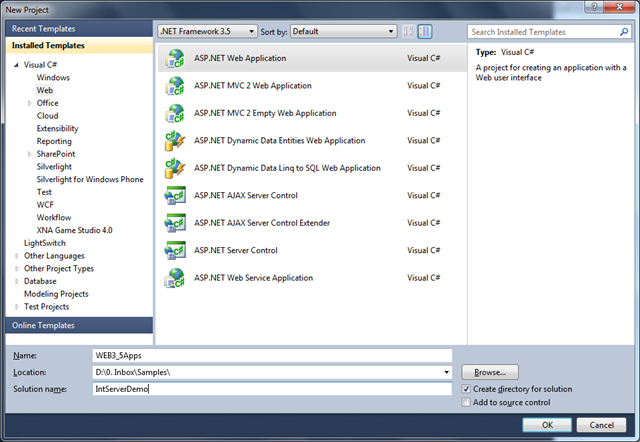
To demonstrate it, Start with a new Visual Studio Instance, and Create a solution file which contains two different Framework version of web applications. Let’s say there are two web application which are targeting to ASP.NET 3.5 and ASP.NET 4.0 version.
What is the difference between Web Farm and Web Garden ? October 1, 2010
Posted by Abhijit Jana in ASP.NET, ASP.NET 4.0, IIS.Tags: ASP.Net, Beginners, codeproject, Difference between Web Farm and Web Garden, IIS, Web Farm Vs Web Garden
34 comments
I have been asked this question many times by different readers of my blog. They wanted to know about the fundamentals of Web Farms and Web Garden . In this blog post I am going to explain the what is the exact difference between web farm and web garden, what are the advantages and disadvantages of using them. I have also described how to create web garden in different version of IIS.
Overview :
Visual Studio having its own integrated ASP.NET engine which is used to run the ASP.NET Web application from Visual Studio. ASP.NET Development Server is responsible for execute all the request and response from client. Now after the end of development, when you want to host the site on some server to allow other peoples to access, concept of web servers comes in between. A web server is responsible for provide the response for all the requests that are coming from clients. Below diagram showing the typical deployment structure of a ASP.NET Web application with a single IIS.
Clients request for resources and IIS Process the request and send back to clients. If you want to know more details on How IIS Process the request please read one of my article over “How IIS Process ASP.NET Request ?” .
Web Farm :
This is the case, where you have only one web server and multiple clients requesting for the resources from the same server. But when there is huge numbers of incoming traffic for your web sites, one standalone server is not sufficient to process the request. You may need to use multiple server to host the application and divide the traffic among them. This is called “Web Farm” . So when you are hosting your single web site on multiple web server over load balancer called “Web Farm”. Below diagram showing the over all representation of Web Farms.
How to remove Hyperlink from ASP.NET TreeView Control Nodes ? September 24, 2010
Posted by Abhijit Jana in ASP.NET, ASP.NET 4.0, Tips and Tricks.Tags: ASP.Net, Beginners, codeproject, Tips and Tricks, Tree View SelectionAction
3 comments
ASP.NET Tree view control rendered as HTML Table – TR –TD elements. Each of the node are been represented as hyperlinks. Some times you may not want that fields as hyperlink and you want to be those nodes should be represent as static text. Many of the developer did the same using font style or css style change of the node, but it can be done very easily. In this small blog post I am going to describe how you can represent a tree view node as simple text instead of hyperlink.
This can be done very easily using Tree Nodes, SelectionAction properties. SelectionAction having 4 different values, they are.
Select is the default option which marked node as hyperlinked and on selection of the node, it raised SelectedNodeChanged event. For Expand Option, TreeNodeExpanded event will be raised while expanding the node. “SelectExpand” raised both the SelectedNodeChanged and TreeNodeExpanded events. Now if you don’t want to make the node as simple text, just change the SelectionAction properties to “None”.